
Lilith, the Black Moon: Shadow, Sovereignty, and the Untamed Feminine
Among the most enigmatic and misunderstood figures of myth and astrology, Lilith, often called the Black Moon, occupies a liminal zone between symbol and absence, myth and mathematical point, demonization and spiritual sovereignty. Unlike planets or luminaries, Lilith has no physical body; yet few astrological factors exert such a visceral psychological and symbolic impact. She represents not what shines, but what refuses illumination; not what integrates easily, but what resists domestication. To speak of Lilith is to speak of exile, autonomy, erotic power, refusal, and the shadow of creation itself.
Lilith’s power lies precisely in her ambiguity. She is not simply “dark” in the moral sense, nor merely transgressive. Rather, she marks the place where social, cosmic, or psychic order fails to contain lived experience—especially female experience—and where something raw, uncompromising, and primordial insists on existing anyway.
I. Lilith in Myth and Historical Imagination
The earliest traces of Lilith appear in Mesopotamian culture, where spirits known as Lilītu or Ardat Lilî were associated with wind, night, disease, erotic obsession, and infant mortality. These were not moral figures but liminal forces—neither fully divine nor human—embodying the dangers of thresholds: dusk, sleep, sexuality, childbirth. From the beginning, Lilith is connected not to evil as such, but to that which escapes regulation.
In Jewish tradition, Lilith enters history more explicitly through later texts, especially the medieval Alphabet of Ben Sira. Here she is described as Adam’s first wife, created equal and from the same earth. Her rebellion is not violent but principled: she refuses sexual submission, insisting on equality—“Why must I lie beneath you?” When Adam refuses, Lilith speaks the ineffable Name of God and leaves Eden. This act marks a decisive shift: autonomy becomes exile, and freedom becomes demonization.
From this moment onward, Lilith is cast as a nocturnal threat: a seductress, a killer of infants, a temptress of men. Yet structurally, she functions as a scapegoat for disobedience, particularly feminine disobedience. She embodies what happens when desire refuses to be aligned with reproduction, obedience, or hierarchy. In this sense, Lilith is not the opposite of Eve, but her suppressed twin: Eve integrated, Lilith expelled.
Later mystical traditions, especially Kabbalistic literature, amplify Lilith’s cosmic role. She becomes associated with the Sitra Achra, the “Other Side,” not as pure negation but as the necessary shadow of creation. Without Lilith, the cosmos would be sterile; with her, it becomes dangerous, erotic, and alive. She is excess—that which cannot be assimilated.
II. From Demon to Archetype: Lilith in Modern Thought
In modern psychology and esotericism, Lilith undergoes a profound revaluation. No longer merely a demon, she becomes an archetype of radical individuation, particularly in relation to sexuality, identity, and autonomy. She represents the part of the psyche that refuses compromise with external authority—whether paternal, divine, or societal.
Unlike Jungian archetypes that tend toward integration, Lilith resists reconciliation. She is not the Shadow waiting to be redeemed; she is the Shadow that does not want redemption. This makes her uncomfortable, especially in spiritual systems oriented toward harmony or transcendence. Lilith does not transcend; she withdraws. She does not heal; she separates. Her function is not wholeness, but truth without consolation.
This is why Lilith often appears in moments of crisis: sexual trauma, rejection, taboo desire, radical independence, or creative isolation. She is the voice that says: “I will not be owned—even if the cost is exile.”
III. Lilith in Astrology: The Black Moon
Astrologically, Lilith is not a planet but a mathematical point—most commonly the lunar apogee, the point where the Moon is farthest from Earth. Symbolically, this is crucial: Lilith marks the place of maximum distance from emotional security, nourishment, and belonging. Where the Moon seeks connection, Lilith marks separation.
There are multiple Liliths used in astrology—Mean Lilith, True Lilith, asteroid Lilith—but the Black Moon Lilith functions as a psychic wound that refuses domestication. It shows where instinct, sexuality, anger, or autonomy cannot be safely expressed and therefore become charged, distorted, or hyper-conscious.
Lilith is not “what you lack,” but what you cannot give up without losing yourself.
Lilith by Sign
By sign, Lilith describes the style of rebellion:
- In Aries, Lilith refuses submission through rage, independence, and confrontation.
- In Taurus, she disrupts possession, body norms, and material security.
- In Gemini, she destabilizes language, truth, and narrative authority.
- In Cancer, she marks maternal ambivalence and exile from emotional safety.
- In Leo, she challenges visibility, ego, and the right to shine.
- In Virgo, she rebels against purity, usefulness, and control.
- In Libra, she exposes power asymmetries in relationships.
- In Scorpio, her domain intensifies: sexuality, death, and taboo merge.
- In Aquarius, Lilith becomes ideological exile, radical difference.
- In Pisces, she dissolves boundaries, refusing salvation narratives.
Lilith by House
By house, Lilith indicates where life will not conform—no matter how much effort is applied.
In the 7th house, she often manifests as rejection of traditional partnership or repeated relational crises.
In the 10th, she challenges authority and public legitimacy.
In the 12th, she becomes an internalized exile, often linked to unconscious rage or spiritual alienation.
IV. Lilith in Significant Charts
Lilith becomes particularly visible in the charts of figures who embody radical autonomy, taboo-breaking, or cultural exile.
In charts of artists, mystics, or revolutionaries, Lilith often aligns with personal planets or angles, signaling a life lived at the edge of acceptability. In female figures especially, strong Lilith placements correlate with projection: admiration and vilification coexist.
In collective charts—revolutions, cultural movements—Lilith marks moments when suppressed forces erupt without negotiation. She does not reform systems; she exposes their limits.
V. Lilith in Aspect: When the Black Moon Touches the Personal and the Collective
Lilith’s astrological force intensifies dramatically through aspects, especially conjunctions. While sign and house describe the field of exile, aspects describe the experience of it. Unlike planets, Lilith does not “act”; she provokes. She draws projection, conflict, fascination, rejection. Wherever she touches, normal rules fail.
Lilith Conjunct the Sun
When Lilith conjoins the Sun, identity itself becomes contested territory. These individuals often experience early rejection or misrecognition, as if their very existence violates an unspoken rule. Authority figures—especially paternal or institutional—tend to clash with them. There is often a strong sense of “I must be myself even if it costs me visibility or belonging.” Charisma here is dark, magnetically polarizing. Public projection is intense: admiration and hostility coexist.
Lilith Conjunct the Moon
This is one of the most psychologically charged placements. Emotional safety is disrupted at its root. The maternal bond may be ambivalent, interrupted, or marked by rejection, absence, or suffocation. The native learns early that vulnerability is dangerous. As adults, they may oscillate between fierce independence and a craving for absolute intimacy that feels impossible to sustain. This Lilith often appears in charts marked by trauma, but also by exceptional emotional intelligence forged in exile.
Lilith Conjunct Mercury
Here Lilith contaminates language. Speech becomes dangerous, taboo, or subversive. These individuals often feel punished for speaking truth, especially in childhood. Silence may alternate with verbal intensity. Writing, poetry, or encrypted forms of communication become privileged channels. This placement is common among thinkers who destabilize dominant narratives.
Lilith Conjunct Venus
This conjunction lies at the heart of Lilith’s erotic mythology. Love, desire, and value become sites of conflict. The native may experience being desired but not loved, idealized but rejected, or loved only under conditions that feel suffocating. Conventional femininity or masculinity is often refused. Sexuality becomes a domain of power, vulnerability, and projection rather than comfort. This placement is frequent in the charts of figures who redefine beauty, gender, or erotic norms.
Lilith Conjunct Mars
Desire becomes militant. Anger, sexuality, and will fuse into a volatile force. These individuals may struggle with rage—either suppressed or explosive—or with being perceived as threatening when asserting themselves. In its integrated form, this conjunction produces formidable courage and uncompromising agency; in its shadow form, it attracts conflict and persecution.
Lilith Conjunct Saturn
Exile becomes structural. Rejection is institutionalized, often internalized as guilt or self-denial. Authority is experienced as hostile or absent. Yet this placement can generate extraordinary ethical rigor and integrity. These individuals do not obey blindly; they test every law against lived truth. Many late-blooming figures carry this signature.
Lilith Conjunct Uranus, Neptune, Pluto
In outer-planet conjunctions, Lilith becomes generational. With Uranus, she fuels radical difference and social rupture. With Neptune, she dissolves spiritual illusions and exposes false transcendence. With Pluto, she enters the underworld fully—sexuality, power, death, and rebirth intertwine. These conjunctions often appear in charts of individuals who catalyze cultural shadow-work.
VI. Lilith in Male and Female Charts: Beyond Gender, Not Beyond the Body
While Lilith is often associated with the feminine, her function is not gender-specific. What differs is how the culture allows—or forbids—its expression.
In female charts, Lilith frequently manifests through projection. The woman becomes a screen onto which desire, fear, and taboo are cast. She is alternately eroticized and punished, idealized and excluded. Strong Lilith placements often correlate with women who are labeled “too much”: too sexual, too independent, too intelligent, too uncontrollable. The cost of autonomy is visibility under hostile scrutiny.
In male charts, Lilith often operates internally. She may appear as fear of the feminine, fascination with forbidden women, or discomfort with vulnerability and dependence. Men with prominent Lilith placements may oscillate between idealization and rejection of women, or struggle to integrate their own instinctual life without shame. When integrated, Lilith in male charts produces profound respect for autonomy and difference; when unintegrated, she fuels projection and repression.
Crucially, Lilith exposes the fault lines of gender itself. She does not conform to roles—maternal, erotic, protective, dominant—but reveals them as constructs that fracture under pressure.
VII. Lilith in the Charts of Significant Figures
Lilith becomes especially visible in the charts of artists, mystics, rebels, and cultural outsiders. While specific examples vary, certain patterns recur with striking consistency.
Figures who challenge sexual norms, religious authority, or political legitimacy often carry Lilith conjunct personal planets or angles. Their lives frequently include exile—literal or symbolic—censorship, scandal, or posthumous recognition. Lilith marks those who speak too early, desire too freely, or refuse compromise with power.
In revolutionary charts, Lilith often aligns with Uranus or Pluto, signaling moments when suppressed forces erupt violently or irrevocably. These are not reforms but ruptures. Lilith does not negotiate with systems; she reveals their breaking point.
In artistic charts, Lilith correlates with styles that disturb rather than please, that seduce and repel simultaneously. Beauty becomes unsettling; harmony is broken to reveal truth.
VIII. Lilith and the Contemporary World
In the twenty-first century, Lilith has returned with unprecedented force. Debates around gender, autonomy, sexuality, reproductive rights, and identity activate her symbolism daily. Lilith is no longer hidden in myth; she operates openly in cultural conflict.
Yet her danger remains. When Lilith is politicized without depth, she becomes caricature—either demonized again or flattened into slogan. Her true function is not rebellion for its own sake, but the refusal of false reconciliation. She insists that certain wounds cannot be healed without first being acknowledged as real.
Astrologically, Lilith today functions as a diagnostic tool. She shows where collective narratives fail, where inclusion is promised but not delivered, where autonomy is celebrated rhetorically but punished materially. She asks not for harmony, but for honesty.
IX. Lilith, Sexuality, and Eros: Desire Without Redemption
Lilith’s association with sexuality is often simplified, reduced to erotic excess or deviance. This misunderstanding stems from the projection of moral frameworks onto what is, in essence, an ontological problem. Lilith does not represent sexuality as pleasure, nor eros as union. She represents desire that does not aim at reconciliation.
Where Venus seeks reciprocity and Mars seeks satisfaction, Lilith seeks sovereignty of desire itself. She asks not “Who do I desire?” but “Under what conditions am I allowed to desire at all?” In many charts, Lilith marks the place where desire has been shamed, punished, or made conditional—often early, often silently. As a result, sexuality becomes charged with defiance, secrecy, or intensity.
This is why Lilith sexuality can feel compulsive or disruptive: not because it is excessive, but because it has been exiled from legitimacy. The psyche does not forget this exile. Desire returns sharpened, uncompromising, sometimes destructive—not to harm, but to assert existence.
In its integrated form, Lilith sexuality is neither promiscuous nor ascetic. It is selective, autonomous, and non-negotiable. It refuses coercion, performance, or role-playing. It does not exist to soothe another’s insecurity or fulfill a narrative. This is profoundly threatening to cultures that instrumentalize sexuality—whether through repression or commodification.
X. Lilith and Motherhood: The Forbidden Ambivalence
One of the most taboo dimensions of Lilith concerns motherhood. While myth casts her as a child-killer, this grotesque image masks a deeper truth: Lilith represents the refusal of compulsory motherhood.
In psychological and astrological terms, Lilith does not oppose children; she opposes the idea that womanhood is fulfilled through maternal sacrifice. She gives voice to ambivalence—the unspeakable truth that care can coexist with resentment, love with exhaustion, creation with loss of self.
In charts where Lilith strongly aspects the Moon, the 4th house, or Cancer, themes of maternal conflict frequently emerge—not always externally, but internally. These individuals may fear becoming mothers, reject it entirely, or struggle with guilt over their own unmet needs. Lilith exposes the cost of idealized motherhood and the violence done to women who do not conform to it.
Importantly, Lilith here is not anti-nurturing. She is anti-erasure. She insists that creation must not annihilate the creator.
XI. Lilith and Eclipses: When the Black Moon Speaks Loudly
Lilith becomes especially potent when activated by eclipses, particularly lunar eclipses that already destabilize the Moon’s domain. When an eclipse aligns with natal Lilith, unresolved material erupts—often suddenly, often irreversibly.
These moments frequently coincide with:
- abrupt endings of relationships
- revelations of hidden dynamics
- withdrawal from roles that have become intolerable
- acts of refusal that shock others but feel inevitable to the individual
Unlike planetary transits that allow gradual integration, Lilith-eclipse contacts tend to operate as points of no return. Something is named, exposed, or abandoned. The psyche crosses a threshold and does not go back.
Collectively, eclipses activating Lilith correspond to moments when cultural taboos surface—often violently—forcing societies to confront what they have refused to see: abuse, hypocrisy, exclusion, structural injustice. Lilith does not whisper at eclipses; she breaks silence.
XII. Lilith in Synastry: Projection, Fascination, and Fear
In relational astrology, Lilith is one of the most volatile indicators. When one person’s Lilith strongly aspects another’s personal planets, projection becomes unavoidable.
The Lilith person is often perceived as:
- irresistibly attractive or deeply unsettling
- dangerous, immoral, or corrupting
- liberating and threatening at the same time
These relationships rarely feel neutral. They awaken forbidden desires, unresolved wounds, or latent fears. The danger lies not in Lilith herself, but in the inability of the other to tolerate autonomy without control.
Many Lilith synastry connections end dramatically—not because love was false, but because the relationship demanded a level of psychological honesty that could not be sustained. Lilith does not tolerate denial. She reveals what each person refuses to acknowledge about power, desire, and freedom.
XIII. Toward a Philosophical Synthesis: Lilith as Ontological Refusal
Ultimately, Lilith cannot be reduced to trauma, sexuality, or rebellion. She represents something more radical: the refusal to exist on false terms.
Philosophically, Lilith occupies the space of negative freedom—freedom not as choice among options, but as withdrawal from illegitimate demands. She says: “I will not participate in a world that requires my self-erasure.”
This is why Lilith cannot be integrated in the conventional sense. She does not seek harmony. She seeks truth prior to reconciliation. Any spirituality, psychology, or astrology that attempts to “heal” Lilith by softening her edges misunderstands her function.
Lilith is not the wound to be healed.
She is the limit beyond which healing becomes complicity.
In this sense, Lilith is not anti-cosmic but a necessary counterforce to false order. She guards the boundary between participation and self-betrayal. Where she stands, something ends—and something real, if often solitary, begins.
But why did Luigi Pericle withdraw from the world?
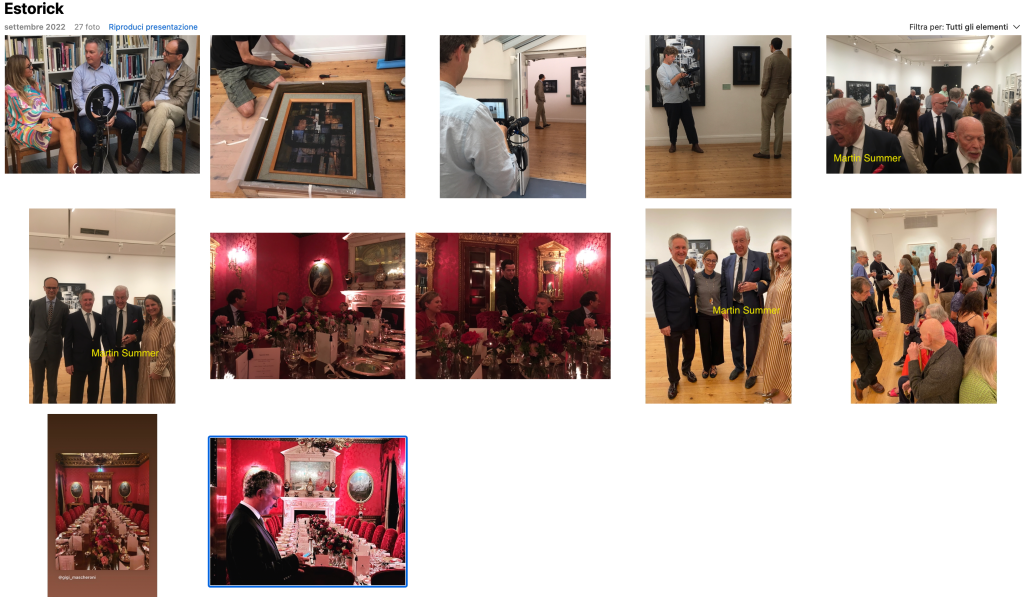
Martin Summer at the Vernissage of Luigi Pericle’s Expo in London
…. Martin Summers, still young, is director of the Tooth Gallery in London and organizes Pericle’s exhibitions. I read in Pericle’s diary that the bond between them is broken…
The following stories found on the internet occurred later, in the 1980s, and “perhaps” have nothing to do with Luigi Pericle’s withdrawal from the “beautiful” world… what is certain is that Luigi Pericle was a painter, scholar, homeopath, acupuncturist, mystic…
In the party stories of his former gallery owner Martin Summers I find:
Cocaine was the drug of the moment. In 1981, art dealer Martin Summers and his wife, fashion stylist Nona Gordon Summers, threw a party in honor of Jack Nicholson.

Nona and Martin Summers partying in Paris with Diane von Furstenberg and family, Mick Jagger and Jerry Hall .
Those fabulous and scandalous 80s parties with Mick Jagger, Andy Warhol and Jack Nicholson
In this book, English aristocrat Natasha Fraser-Cavassoni tells us about the art of having fun (and not caring about annoying advances) in the carefree 1980s.
by Natasha Fraser-Cavassoni
February 16, 2018
Courtesy Photo
I just went to a fun party in London , which was pretty much an exception. It was held on several floors of a house in South Kensington , and it was “exceptionally fun” for more than one reason. No one was standing around taking selfies or staring at their iPhones. Everyone was having pleasant conversations, downing champagne and enjoying risotto, which was simmering in a giant saucepan, while being attended to by three wonderful Italians. The doorbell kept ringing, a flood of new people poured in, and our guests introduced themselves with the same humor and affability. No special treatment for their famous friends. And, as one basket of Tuscan bread after another was devoured, I never once heard the phrase “gluten intolerance” uttered: ah, what a relief.
Don’t get me wrong. I love being a 55-year-old single mom living and earning a living in Paris. But, in general, I think parties aren’t that exciting anymore; they’ve become banal, boring. That London evening, however, was like stepping back into the carefree 1980s , when—as I wrote in my memoir After Andy —my friends and I would have fun at social events, art gallery openings, and the occasional fashion event. We were authentic and spontaneous; for us, the opportunity to meet soulmates, or potential love, was more important than our professional reputation or posing for an Instagram account.
Courtesy Photo
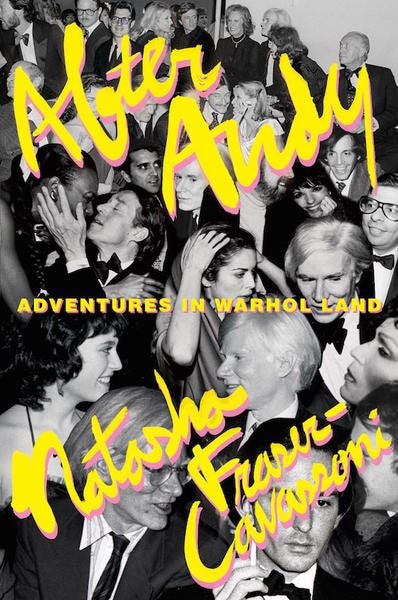
The cover of Natasha Fraser-Cavassoni’s memoir After Andy: Adventures in Warhol Land (Blue Rider Press), featuring insider stories of her life at Andy Warhol ‘s Factory , partying, working for Interview magazine , W , and Harper’s Bazaar .
It’s true, we were young, but different within our wider London entourage. We worked hard during the day, but had fun at night; that was what united us, what made us all the same, certainly not the current obsession and/or fear of exchanging—24/7—information about success, famous friends, and money. Yes, there were super-rich people in the ’80s, but they weren’t many, and above all, they didn’t wave their money in your face. Restaurant bills were taken and paid discreetly.
The rule was to know how to fit in and have something special: to be monstrously arrogant but extraordinarily sharp and witty, or very talkative and charming, or quiet and shockingly beautiful. I was a chatterbox. Having a father who was in politics, I felt incredibly at ease in social situations and could literally hold a conversation with a door. This is how I became friends with that quintessential Southern belle, Marguerite Littman. She lived in Belgravia and was famous for long lunches at her house, which lasted hours and seemed never-ending. Imagine a menu of impeccable mini cheese soufflés, countless white orchids—then unknown—, drawings by David Hockney , and a mix of guests that included playwright Tennessee Williams , poet Stephen Spender , Elizabeth Taylor , Bianca Jagger , and Andy Warhol .

Courtesy Photo
Natasha Fraser-Cavassoni in 1981 with Brazilian playboy Roberto Shorto and artist David Hockney (photo Soevermedia)
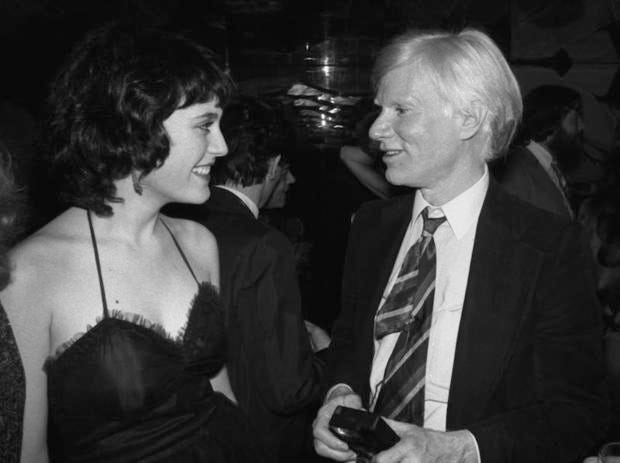
Marguerite preferred to appear a little silly and whimsical rather than intellectual and/or pretentious because that made everyone feel comfortable. But she prided herself on her flair and her talent for social interaction. And in February 1980, when a full-page portrait of me appeared in the British edition of Vogue, she introduced me to Warhol, who was always looking for women who were beautiful or loved to chat. The first time we met, the American artist tried to match me with a guy who modeled for Armani. I laughed, and he burst out laughing too. Then, the second time we met—at the Régine nightclub for a party in his honor—even though Andy was shocked that my black tulle tutu dress cost only 20 pounds, I followed him everywhere, while he continued to take photos.
I wasn’t exactly elegant—I was sixteen, with a shock of black hair that I dyed myself an inky color. I squeezed my soft, less-than-toned curves into cheap vintage dresses, but I was very curious and had a fantastic joie de vivre. Vogue had called me one of the beauties of the ’80s—”the world is theirs,” the magazine had predicted—but like most upper-class people, I didn’t care what anyone else thought. Parties were supposed to be carefree and fun, you were supposed to experiment with all kinds of drugs and exotic cocktails, and since it was pre-AIDS, promiscuity was rampant. Even the most famous rock stars were accessible, and they arrived without any courtesies.
They might have been accompanied by a bodyguard, but they made their own phone calls. I realized this when I had an affair with Mick Jagger . He was the one who took care of everything, from getting tickets to a Stevie Wonder concert to booking a table at Ken Lo’s Memories of China—a very trendy Chinese restaurant—and all this while remaining down to earth, and always with exquisite courtesy. If we took a taxi, he would graciously sign autographs for the taxi drivers, and when he got tickets to Muhammad Ali’s last boxing match, he didn’t request a special cordoned off seat for himself and the Rolling Stones. Out in the foyer, Mick, Keef ( Keith Richards , ed.) and the others sipped beer from plastic cups like everyone else. When they weren’t on stage, the Stones were relaxed, unlike Iggy Pop, the “wild man” of rock ‘n’ roll. I met him through Malcolm McLaren, the Sex Pistols’ manager, and although he was charismatic, Iggy was what you’d call a total cocaine addict.
Cocaine was the drug of the moment. In 1981, art dealer Martin Summers and his wife, fashion stylist Nona Gordon Summers, were throwing a party in honor of Jack Nicholson , and there was more excitement in their marble-clad bathrooms than in the salon designed by star interior designer Renzo Mongiardino. Naturally, I was looking for the white powder. Which caused a small problem. I found a large pile of cocaine, but inadvertently swept another pile with my skirt and dumped it into a sink. It actually happened, and it was such a shock that my cousin—who was sitting in the bathtub waiting her turn—almost fell in laughing. We thought no one else had seen my heinous deed until the landlord insisted on taking a picture of us, each of us standing on either side of Uncle Jack.
I felt the movie star’s hand slide up my thigh until it touched my ass. “I won’t tell anyone if you don’t either,” Nicholson whispered to me. I was surprised but didn’t feel harassed because he was cheeky and funny. Plus, Nicholson was ridiculously sexy, with a killer smile and a “bed face.” Of course, London had its share of Harvey Weinstein types and nasty perverts. At Annabel’s, the painter Lucian Freud had rubbed himself against me, armed with a huge erection. It was the only time in my entire life I was scared, even though we were on a dance floor surrounded by people. Afterward, however, I told my friends about it and we concluded he was a poor asshole. Just like the men who tell the world about their conquests, considered part of the same category. All misogynistic idiots. But it was all out in the open. The disrespectful men and the sexual advances we endured were the downside of that life lived to the fullest. We certainly didn’t let them ruin our lives, though. Life had to be seized by the horns. We refused to feel like victims of some idiot, absolutely not.
This is also why the recent scandals and allegations of sexual abuse have deeply saddened me. You can’t prevent horrendous people like Harvey Weinstein from behaving monstrously, but you can stop writing about them and thus prolong their abuse of power. Why not instead turn the tables? Interview Weinstein and discover what makes him act like a monster. Learn more about his sexual problems and perversions instead of painting him as an incomprehensible black hole. Toward the end of his life, Donald Cammell , the director of Sadism , had problems because he had a very young girlfriend. But I met them at the home of film producer Hercules Bellville, and they were crazy about each other. Each in their own way, and shouldn’t we respect rather than judge and condemn?
In my experience, Donald was an eccentric with a wonderful sense of humor. He wanted me to play the Queen of Naples in the film he was planning to make about Emma, Lady Hamilton. “You’ll emerge from the sea with your bare breasts wrapped in lace,” he explained. I said yes on the condition that he appear wearing a pair of trousers similar to the swimsuit I was supposed to wear, and he burst into laughter. When I remember those frenetic and crazy years, I smile and hope my daughters, who are sixteen, will have as much fun as I did when I was twenty, because being happy is the best revenge.
Natasha Fraser-Cavassoni , born in 1963, is an English aristocrat, one of six children of politician Sir Hugh Fraser and Lady Antonia, a writer and historian who later married playwright Harold Pinter. Natasha is a writer and journalist for various international publications. She also worked for Chanel with Karl Lagerfeld. She currently lives in Paris with her two daughters.
courtesy Soevermedia
Room 237 Woman (English Summary)
In Stephen King’s novel The Shining, the ghost in Room 217 (changed to 237 in Kubrick’s film) is Lorraine Massey, a former hotel guest who committed suicide in the bathtub after her lover abandoned her. She appears seductive at first but transforms into a decaying corpse, symbolizing temptation turning to horror and the hotel’s corrupting influence.screenrant+1
Relation to Lilith
Lorraine embodies Lilith-like archetypes: a seductive, independent woman linked to death, sexuality, and revenge against male abandonment (Lilith as Adam’s rebellious first wife in Jewish mysticism). Her transformation from alluring siren to monstrous figure mirrors Lilith’s demonized femininity—devouring, castrating, unbound by patriarchy. Kubrick’s anonymous version amplifies this as esoteric shadow-feminine, though King names her explicitly without mythic reference.reddit
 Andrea Biasca-Caroni
One thought on “Lilith”